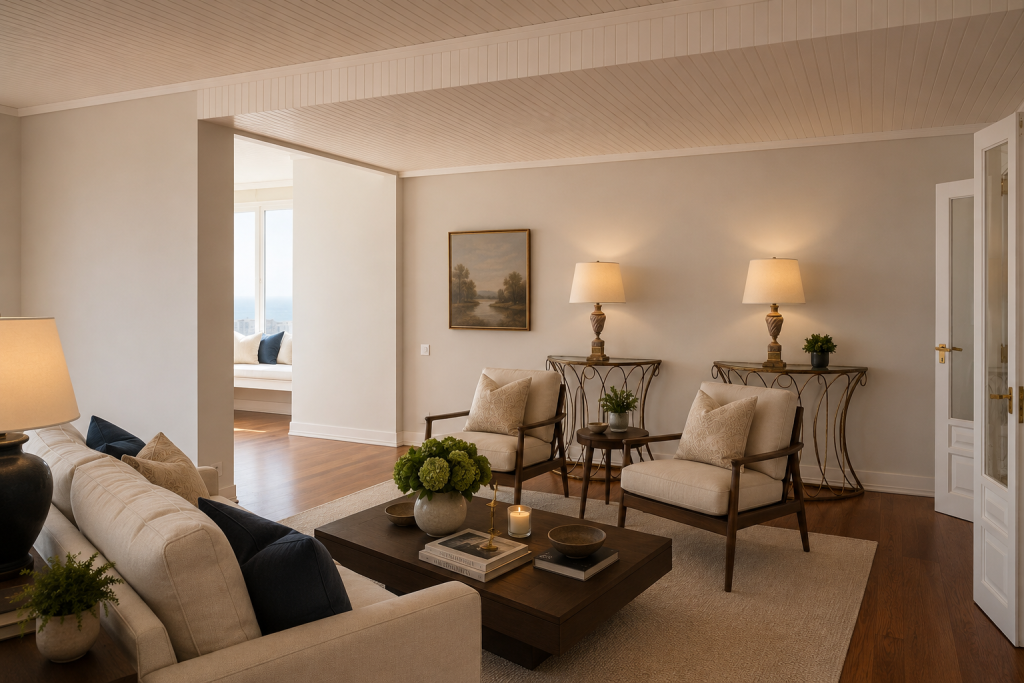

So. You have a beautiful house. Or at least, you think you should.
Because somehow, the sofa is always in the wrong place, the dining table blocks the walkway, there is never enough storage, and someone is always turning on the wrong light.
And the one chair everyone actually wants to sit in? It is somehow never in the right room.
Sound familiar?
This is where interior design comes in. And no, I don’t mean filling a house with expensive furniture, perfectly arranged cushions and objects nobody is actually allowed to touch. Good interior design is much more practical than that. It’s about how your home feels and, perhaps even more importantly, how it works. How you move through it. Where the light falls. Where people naturally gather. Where you put the things you use every day — and whether your home actually supports the way you live.
Because a beautiful room that doesn’t work for you isn’t really a successful room. It’s just a pretty problem.
Before We Choose Anything, Let’s Talk About How You Live
This is where I always want to start. Not with paint. Not with tiles. And definitely not with a furniture catalogue. With you.
How do you actually use your home? Do you cook every day? Work from home? Do your children leave shoes absolutely everywhere? Do friends come over often? Do you need somewhere quiet to work or read? And perhaps the most revealing question of all: do you actually eat at the dining table, or does everyone somehow end up at the kitchen island?
These things matter because home interior design should be designed around your life — not the other way around. I don’t want you constantly adapting your routine to suit your house. I want the house to make your routine easier.
That is where good design begins.
Then We Look at the Layout
Sometimes a room isn’t uncomfortable because there’s something wrong with the furniture. It’s uncomfortable because the layout is wrong. The sofa is too far from the television. The dining table is squeezed into a corner. There’s nowhere sensible to put a coffee table. The kitchen feels disconnected from the living room. Or perhaps you have an enormous room that somehow feels completely useless. This is where interior planning becomes important. Before we start moving furniture around, I want to understand how the space connects. Where do you enter? Where do you naturally walk? Where does everyone gather? What needs to be accessible, and what can happily disappear?
Sometimes the solution is surprisingly simple. Move the sofa. Change the dining table. Open up a sightline. Create a better connection between two spaces. You don’t always need to knock down a wall to make a home work better. Sometimes you just need to stop putting the furniture in the same place because that’s where it has always been.
And Then We Talk About Light
I love talking about light because it can completely change a room. Natural light can make a space feel larger, warmer and more welcoming. But it isn’t simply about having lots of windows. Where does the morning light come from? Which room gets that wonderful evening glow? What happens in the afternoon? Where are the darker corners? Where do you need proper task lighting, and where do you want something softer?
And what happens after sunset?
Lighting should be part of the design rather than something we suddenly remember when everything else is finished. A beautiful room with harsh overhead lighting can feel completely different at night. And nobody wants to spend the evening sitting underneath what feels like an interrogation lamp. Good lighting should help you see. But it should also help you feel.
Materials Need to Survive Real Life
This is the fun part.
Well. It can be. Until you realise how many varieties of stone, wood, tile, flooring and fabric exist and suddenly choosing a kitchen worktop feels like a major life decision. Materials matter for more than appearance. I want to know how they feel, how they age, how much maintenance they require and what happens when actual human beings start living with them. Do you have children? Dogs? Lots of dinner parties? Sandy feet coming home from Guincho? A tendency to put red wine dangerously close to pale upholstery?
These are useful things to know.
The most expensive material isn’t automatically the best one. And something that looks spectacular in a showroom but requires constant attention may not be particularly spectacular six months later. Materials should make sense for the property and for the people living there.
That’s the difference between decorating a room and creating functional interiors.
Furniture Should Work Harder Than It Looks
Furniture is one of the easiest ways to completely change how a home functions. But bigger is definitely not always better. That enormous sofa may look wonderful in the showroom. Then you get it home and suddenly nobody can walk around it. The same applies to dining tables, beds, sideboards, armchairs and coffee tables.
Furniture needs to fit the room, but more importantly, it needs to fit the way you use the room.
Perhaps you need flexible seating when friends come over. A dining table that expands. A desk that disappears when the working day ends. A proper reading chair. Or a sofa capable of surviving children, guests, dogs and the occasional glass of wine. The goal isn’t to fill every empty space. It’s to make the right spaces useful.
Ah. Storage.
The thing nobody thinks about until they don’t have enough of it.
Then suddenly every cupboard becomes extremely important.
Where do the coats go? The shoes? Books? Cleaning supplies? Kitchen appliances? Bed linen? Suitcases? And where do we put all those things we bought because they were beautiful but have absolutely no idea what to do with? Good storage can make a home feel calmer almost immediately. Built-in cabinetry, integrated wardrobes, under-stair storage, window seats, clever kitchen cupboards and furniture that quietly does more than one job can completely change the experience of living in a house. And the best storage often disappears into the design. You don’t walk into the room and think, “What magnificent storage.” You simply notice that the house feels easier to live in.
Your Home Should Still Look Like You Live There
This is important.
I don’t want every home to look like the same photograph from the same magazine. Your home should have personality. Maybe you love old furniture. Maybe you prefer clean lines. Perhaps you want colour everywhere, or almost no colour at all. Maybe your house is full of books. Maybe you have things you’ve collected over twenty years that would make absolutely no sense in somebody else’s home.
Keep them.
Good home décor isn’t about creating a showroom. It’s about creating somewhere that feels like yours. The most interesting interiors nearly always contain something personal: a piece of art, an old table, a chair you absolutely refuse to replace, photographs, books, or some strange little object with a story nobody understands except you. Those are the things that give a house soul. We can work around them.
A House Has a Rhythm
Rooms don’t exist independently of one another.
The hallway connects to the living room. The living room connects to the kitchen. The kitchen might open onto the terrace. The bedroom connects to the bathroom. The whole house has a rhythm. And that rhythm matters. You should be able to move through your home naturally. You shouldn’t have to navigate around furniture, carry laundry through three rooms because there is nowhere sensible to store it, or walk across the entire house to find the bathroom everyone seems to be using. This is where thoughtful interior planning makes such a difference.
We stop looking at the house as a collection of individual rooms and start looking at it as a whole.
Sometimes the Best Design Decision Is to Do Less
This may surprise you.
More isn’t always better. More furniture. More colour. More decoration. More built-ins. More features. More things. Sometimes a room needs less. More space around the furniture. A clearer sightline. A quieter palette. One wonderful piece rather than five average ones. A room needs breathing space. And that empty corner you have been desperately trying to fill? Perhaps it doesn’t need anything. It is perfectly happy being empty. Let it be.
If You’re Renovating, We Need to Think Bigger
This is where interior renovation becomes particularly interesting.
If you’re already changing a kitchen, bathroom or several rooms, it makes sense to step back and look at how everything works together. Maybe the kitchen needs better storage, but perhaps the bigger issue is that it doesn’t connect properly with the dining area. Maybe the lighting throughout the ground floor needs reconsidering. Perhaps the flooring should continue through several rooms rather than stopping and starting.
Maybe a doorway is in the wrong place. An awkward corner could become a useful workspace. Or perhaps the room everyone keeps trying to “decorate better” actually needs to function differently. A renovation gives you an opportunity to solve problems you may have been living with for years. Take advantage of it. But don’t renovate simply because you can.
Renovate because it makes the house better for you.
This Is Where Good Interior Design Really Matters
At Wiley & Partners, I don’t think interiors should be treated as something that happens after the property has been bought and everything else has been decided.
How a house can work should be part of the conversation much earlier.
Sometimes I walk into a property with a client and can immediately see that the room they dislike isn’t actually a bad room. The furniture is wrong. Or the lighting. Or the proportions. Or nobody has figured out what the room wants to be.
A better layout can completely change how you see a property. Clever storage can change your everyday routine. The right lighting can transform the atmosphere. Thoughtful materials can make a house both beautiful and practical.
So I like to look at everything.
The architecture. The light. The layout. The materials. The furniture. And, most importantly, the way you live. Because ultimately, the house needs to work for you.
If you’d like to see how we approach this, you can explore our interiors service.
What I Really Want You to Remember
Good interior design isn’t about having the most fashionable home.
It isn’t about buying the most expensive furniture. And it certainly isn’t about creating a house that looks as though nobody actually lives there. It’s about making everyday life easier. Better storage. Better light. Better movement. Better proportions. Materials that make sense. Furniture that earns the space it occupies. Rooms that have a purpose. And spaces that feel like you. Beauty matters. Of course it does. But comfort matters too. Function matters.
And the magic happens when you stop believing you have to choose between them.
Something Isn’t Working…
If you’re standing in your home thinking exactly that, resist the temptation to immediately buy another piece of furniture. Instead, walk through the house. Notice where you naturally move. Notice where things always pile up. Notice the chair nobody ever sits in, the room that always feels too dark, the cupboard everyone fights with and the place where you are constantly searching for something.
Those little frustrations are telling you something. Your home is giving you clues.
Listen to them. Maybe it’s the layout. Maybe it’s lighting or storage. Maybe the furniture is simply wrong for the room. Perhaps you need a larger interior renovation. Or perhaps you just need to look at the space differently. If you’re thinking about improving your home and would like to talk through the possibilities, contact Wiley & Partners.
We’ll start with the house. Then we’ll talk about how you live. And from there, we’ll work out what actually needs to change. Because the best interior isn’t simply the one that looks good. It’s the one that makes you wonder how you ever lived without it.
Frequently Asked Questions
1. What is the main purpose of interior design?
For me, it starts with one simple question: how do you want your home to work?
Good interior design should make everyday life easier through better movement, storage, lighting, comfortable furniture and spaces that genuinely suit the people using them.
Yes, I want it to look beautiful too.
But beauty without function gets frustrating very quickly.
2. How can interior design make a home more comfortable?
Start with the things you notice every day. Is the sofa comfortable? Is there enough light? Can you move around easily? Do you have somewhere sensible to put everything? Does the furniture actually suit the room?
Comfort isn’t always about buying more.
Sometimes it’s about making better decisions with the space you already have.
3. How important is layout in home interior design?
Very.
In fact, I would look at the layout before choosing decorative details. A beautiful room with a poor layout is still difficult to live in.
Furniture needs to fit, walkways need to make sense, rooms should connect naturally, and the space needs to support the way you actually use it.
4. What role does lighting play in interior design?
A huge one.
Natural light changes how a room feels throughout the day, while artificial lighting needs to take over gracefully when the sun goes down.
I prefer thinking about lighting early rather than treating it as the final detail. The right lighting can make a room feel warmer, calmer and infinitely more inviting.
5. How can I improve storage without making my home feel crowded?
Make storage part of the design rather than something added afterwards.
Built-in wardrobes, integrated kitchen storage, under-stair solutions, discreet shelving and furniture with hidden storage can all help.
The best storage doesn’t necessarily announce itself.
It simply makes the house easier to live in.
6. Does good interior design have to be expensive?
Absolutely not.
Sometimes the biggest improvement comes from changing a layout, improving the lighting or simply removing furniture that doesn’t work.
Before buying something new, I always want to ask: do we actually need it?
Sometimes the answer is yes.
Sometimes the answer is absolutely not.
7. How do I choose furniture that works for my home?
Start with the room, not the furniture showroom.
Measure it. Think about how you use it, how people move through it and who will actually be sitting there. Then choose pieces that suit both the space and your lifestyle.
Please don’t buy the enormous sofa simply because it looked fantastic in the showroom.
Your living room may not share the showroom’s floor plan.
8. Should I renovate if my home doesn’t function well?
Maybe.
But first, understand the problem.
If the kitchen layout is wrong, changing the cabinetry might solve it. If storage is the issue, you may not need a full renovation. If several rooms connect poorly, a larger intervention might make sense.
Solve the actual problem.
Don’t renovate simply because the house looks a little tired.
9. How can I make my home feel more personal?
Keep the things that mean something to you.
Art. Books. Photographs. Furniture you’ve collected over time. Objects with a story. A home shouldn’t look as though it was assembled entirely from a catalogue.
The most interesting interiors tell you something about the people who live there.
10. When should I speak to Wiley & Partners about interior design?
Ideally, before you start making lots of expensive decisions on your own — particularly if you’re considering a larger renovation or simply can’t figure out why your current space isn’t working.
Come and talk to me.
We’ll look at the property, talk about how you live and identify what is working — and what definitely isn’t.
Then we can decide what actually needs to change.
Because good interior design doesn’t start with choosing a colour.
It starts with understanding the home.